Two places data needs protecting
- At rest: data sitting in a database, a storage bucket, a backup or on a laptop disk. Protected by turning on encryption for that storage, and by tools such as BitLocker or FileVault on laptops.
- In transit: data moving between a browser and a website, or between two servers. Protected by TLS, the technology behind HTTPS and the padlock in the browser.
Keys are the real control
Encrypted data is only as safe as its key. Companies keep keys in a key management service:
- AWS KMS
- Azure Key Vault
- Google Cloud KMS
Auditors ask:
- Who can use or change the keys?
- Are they rotated?
- Is key access logged?
Hashing is different
Passwords should not be encrypted (which can be reversed) but hashed: turned one-way into a value that cannot be turned back. If a company says it "encrypts passwords", ask what it means.
What this means for evidence
- At rest: the storage setting showing encryption on, with the key used.
- In transit: a TLS scan or load balancer settings showing HTTPS only, with old protocols off.
- Laptops: an MDM report showing every device encrypted.
- Keys: who has access to them, and the rotation setting.
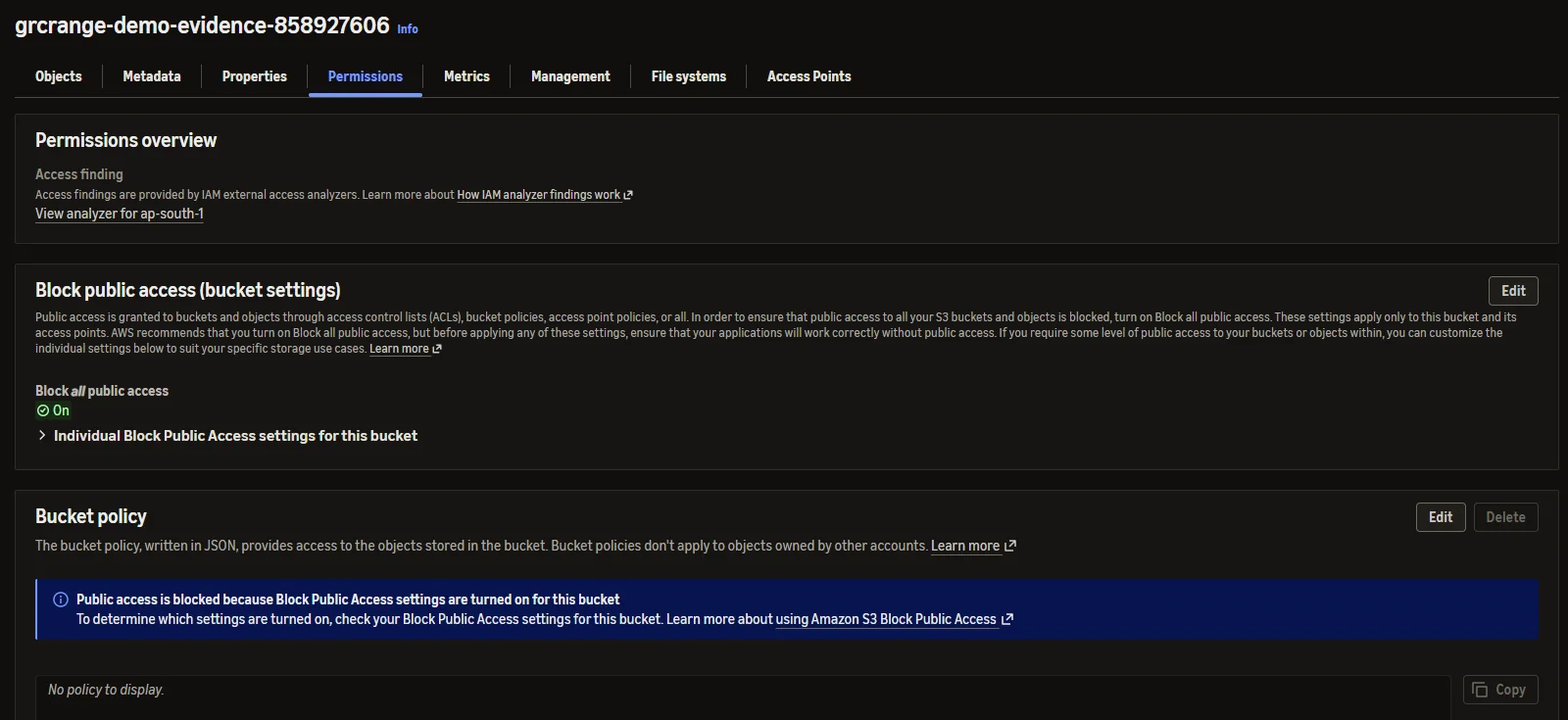
Block Public Access (account settings)
- Block all public accessOn2
- Block public access via new ACLsOn
- Block public access via any ACLsOn
- Block public access via new bucket policiesOn
- Block public and cross-account access via any policiesOn
- Default encryption (all buckets)SSE-KMS, key complyoo-data3
- 1Date and the account. Account-level settings cover every bucket, which is stronger than bucket by bucket.
- 2Block all public access is on for the whole account.
- 3Default encryption with a managed KMS key. This is the encryption-at-rest evidence.
Weak version: Only one bucket's settings, not the account. The auditor cannot conclude anything about the other buckets.

TLS configuration: api.complyoo.com
| Check | Result2 |
|---|---|
| Certificate | Valid until 2027-02-11, trusted issuer |
| TLS 1.2 and 1.3 | Enabled |
| TLS 1.0 and 1.1 | Disabled3 |
| HTTP to HTTPS redirect | Enforced |
- 1Scan date and the exact host scanned.
- 2Each check with its result, from the scanning tool rather than a claim.
- 3Old TLS versions disabled. Leaving them on is a common finding.
Weak version: A browser padlock screenshot shows a certificate exists. It says nothing about which TLS versions are allowed.
Encryption report
| Device | User | OS | Encryption2 | Compliant |
|---|---|---|---|---|
| CMP-LT-031 | arjun.m | Windows 11 | BitLocker: encrypted | Yes |
| CMP-MB-012 | priya.r | macOS 15 | FileVault: encrypted | Yes |
| CMP-LT-044 | sana.k | Windows 11 | BitLocker: encrypted | Yes |
- 1Export date. Compare the device count with the asset inventory to show nothing is missing.
- 2Encryption status per device.
Weak version: Shows the encryption policy exists, not which devices are actually encrypted.
Encrypted at rest, encrypted in transit, and someone accountable for the keys.
1. HTTPS protects data...
2. What makes encrypted data unsafe even when encryption is on?
3. How should passwords be stored?